
Woven vs. Nonwoven Geotextiles: Which Works Best for Road Separation?
Woven vs. Nonwoven Geotextiles: Which Works Best for Road Separation?
Choosing between woven and nonwoven geotextiles for road separation takes more than comparing tensile strength or price. The fabric must keep subgrade soil from contaminating the aggregate layer while allowing appropriate water movement and surviving construction. A material that performs well in one of those areas can still be unsuitable overall.
Woven geotextiles often offer high tensile strength at relatively low strain. Needle-punched nonwovens typically provide greater cross-plane water flow and more elongation. Those are useful starting points—not selection rules. For a road foundation, the better choice depends on the soil, groundwater conditions, aggregate, and how the first lift will be placed.
Start with the failure you need to prevent
Road separation is primarily about preserving the boundary between two materials. Without a suitable separator, aggregate can penetrate a weak subgrade, while fine soil can move upward into the aggregate under water movement and repeated loading. The result is a less distinct, often less effective granular layer.
This is different from proving reinforcement performance. A geotextile may provide separation, filtration, and some mechanical contribution, but a high tensile-strength value alone does not establish how much aggregate thickness can be reduced. Any structural benefit needs an appropriate design method and supporting material properties.
That distinction matters on temporary haul roads over soft ground. If loaded trucks cause substantial rutting, selecting a stronger separator may not solve the underlying bearing-capacity problem. The design may also need thicker aggregate, a revised construction sequence, ground improvement, or a separately evaluated reinforcement system.
What the fabric structure changes
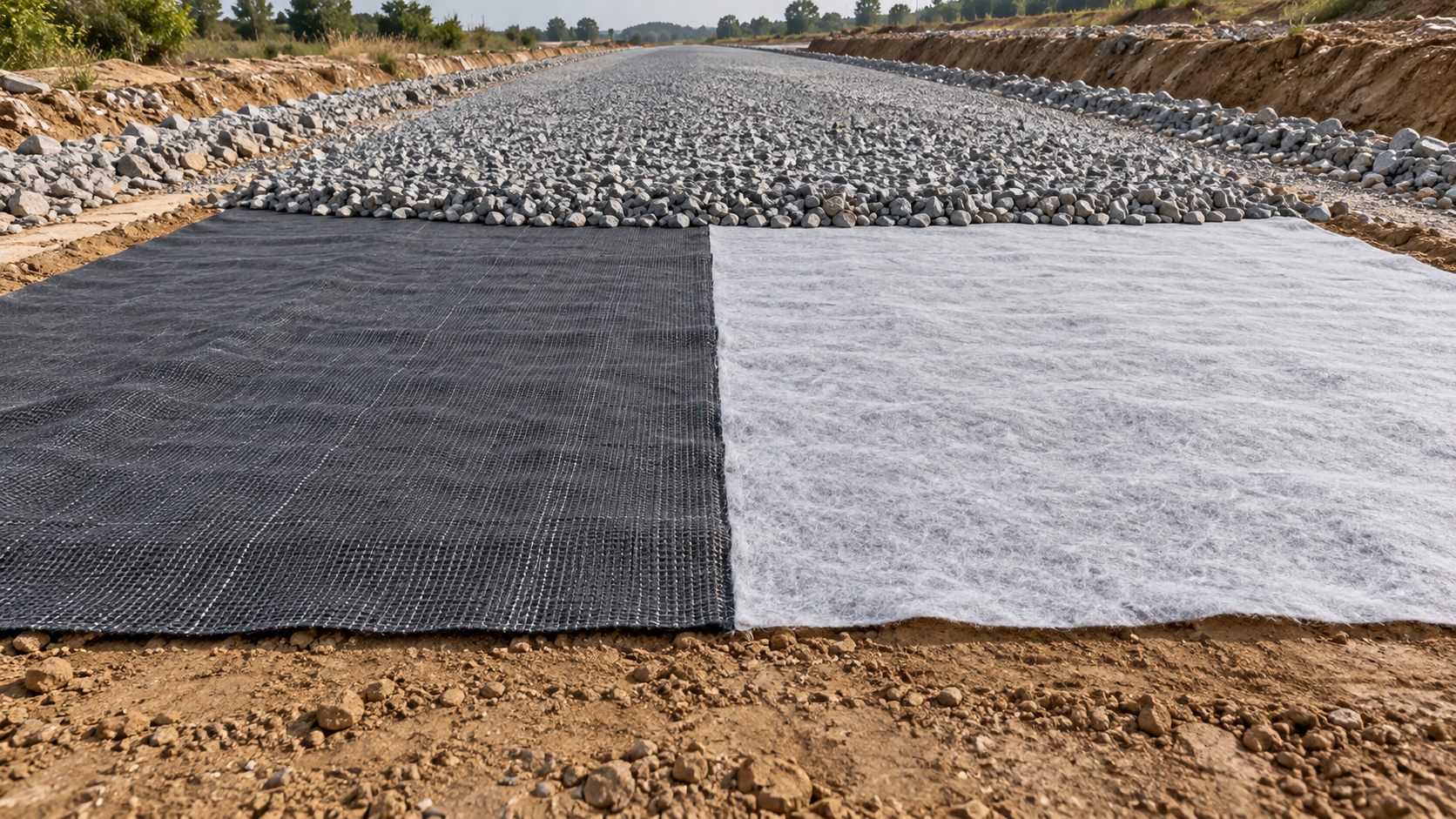
Woven geotextiles are made by interlacing yarns or tapes. Their mechanical and hydraulic behavior varies considerably with yarn type and weave. Slit-film woven products should not be treated as interchangeable with woven monofilament or other engineered woven fabrics, particularly where filtration is demanding.
Needle-punched nonwoven geotextiles have a three-dimensional network of bonded fibers. They generally deform more before rupture and can conform well to uneven ground. Their porous structure often makes them a practical candidate where separation and cross-plane filtration must work together. However, not every nonwoven has suitable opening sizes, strength, or resistance to installation damage.
Let soil and water narrow the choice
On a reasonably firm, well-drained subgrade, separation may dominate the decision. A woven product can be a sensible candidate if it meets the required filtration and installation-survivability criteria. There is little value in buying additional hydraulic capacity that the design does not need, although minimum filtration requirements still apply.
On wet silty ground, the balance changes. Water movement and the potential for fines migration deserve closer attention. A needle-punched nonwoven is often worth evaluating first, but “high permeability” is not enough. Its pore structure must retain the relevant soil fraction without becoming excessively clogged.
The temptation is to specify the smallest available opening size. That can be counterproductive: a fabric that is unnecessarily restrictive may impede flow or encourage blinding at the soil interface. Conversely, openings that are too large can allow unacceptable soil loss. Selection requires a retention-and-flow assessment, not a ranking from smallest to largest pores.
Gap-graded soils, dispersive soils, and conditions involving repeated or reversing flow warrant additional care. Where routine selection criteria do not adequately represent the site, soil–geotextile compatibility testing may be appropriate. A supplier’s clean-water flow result cannot resolve every soil-specific filtration question.
Permeability is not a drainage system
A separator that allows water to pass through its thickness does not automatically carry that water away. Cross-plane flow and in-plane drainage are different functions. If water has no outlet, a highly permeable fabric will not prevent saturation of the road foundation.
Review crossfall, drainage-layer continuity, edge drains, and outlet levels alongside fabric selection. If the design relies on lateral flow within a geosynthetic, evaluate the relevant transmissivity under expected confinement rather than assuming a standard separator provides sufficient drainage capacity.
The first aggregate lift can decide the outcome
A compliant geotextile can still fail during installation. Angular stone, thin initial cover, deep subgrade ruts, and construction traffic create stresses that a headline tensile value does not describe. Often, the critical loading happens before the road is finished.
Consider coarse crushed aggregate being pushed onto a soft, uneven formation. The fabric may span depressions while individual stones impose concentrated loads. Both woven and nonwoven products need sufficient survivability for that combination. A heavier fabric is not automatically the answer; changing the initial lift or placement method may be equally important.
The installation specification should address:
- Subgrade preparation, including removal of sharp protrusions and treatment of unstable areas.
- Initial aggregate cover and placement methods appropriate to the ground and equipment.
- Restrictions on direct trafficking, sudden braking, and turning over exposed fabric.
- Overlap or seam requirements, including how continuity will be maintained on soft ground.
- Inspection and repair procedures before damaged areas are buried.
Avoid copying a single overlap dimension into every project. Softness, expected deformation, placement direction, and the governing specification all affect the detail. Where seams are required, seam performance needs its own verification.
Compare test results—not product labels
An evaluation sheet should separate hydraulic properties from mechanical and durability requirements. Relevant tests may include apparent opening size under ASTM D4751, permittivity under ASTM D4491, grab tensile properties under ASTM D4632, and static puncture resistance under ASTM D6241. The governing specification determines which methods and acceptance values apply.
These results are not interchangeable. Grab tensile strength is not a substitute for wide-width tensile behavior when a design depends on load–strain response. Likewise, water-flow figures measured under different heads or procedures should not be compared as though they were identical. ASTM and ISO results require a method-by-method review, not just unit conversion.
Where AASHTO M 288 is specified, confirm the applicable edition, application category, survivability requirements, and project amendments. “Meets M 288” is too vague to serve as a complete approval statement.
Also distinguish typical values from guaranteed acceptance values. A typical result may describe production performance without defining the contractual minimum. Ask how the declared properties are controlled and reported, including whether minimum average roll values apply. Mass per unit area is useful for identification and quality checks, but it does not replace functional requirements.
Turn the technical choice into a deliverable specification
For imported geotextiles, approval should cover the supplied grade, not simply the manufacturer’s product family. Confirm polymer, construction, roll dimensions, test methods, declared properties, and batch traceability before shipment. A substitution described as “equivalent weight” may have quite different hydraulic or mechanical behavior.
Roll width also affects installed cost. A cheaper narrow roll can require more overlaps, handling, and installation time. Compare cost per covered area after allowing for the actual layout, rather than relying only on the quoted price per square meter.
Shandong Hongyun Special Hose Co., Ltd. supplies geotextiles and geomembranes through an export-oriented service model, with project-specific grades, tailored export packaging, and documentation support. For this type of supply arrangement, the practical priority is to agree on acceptance documents early: test reports, identification labels, and any project-required certification should correspond to the material being shipped.
FOB or CIF terms address commercial responsibilities, not engineering acceptance. Packaging and storage requirements should also protect rolls from handling damage and excessive exposure before installation.
Which should make the shortlist?
For straightforward separation on a reasonably firm, drained subgrade, evaluate a woven product that satisfies filtration and survivability requirements. Where cross-plane flow and filtration are more demanding, evaluate a suitable needle-punched nonwoven—and consider engineered woven alternatives on their measured performance rather than excluding them by category.
For very soft ground or severe construction loading, pause before treating either choice as sufficient. Confirm whether the project needs separation alone or a broader stabilization solution. The final specification should explain why the selected fabric fits the soil, water regime, and installation method. If that explanation rests only on tensile strength, fabric weight, or price, the evaluation is not finished.
Related Posts
Contact Us
Leave A Message
If you are interested in our products and want to know more details, please leave a message here, we will reply you as soon as we can.