
Why Geotextiles Clog in Drainage Systems and How to Prevent It
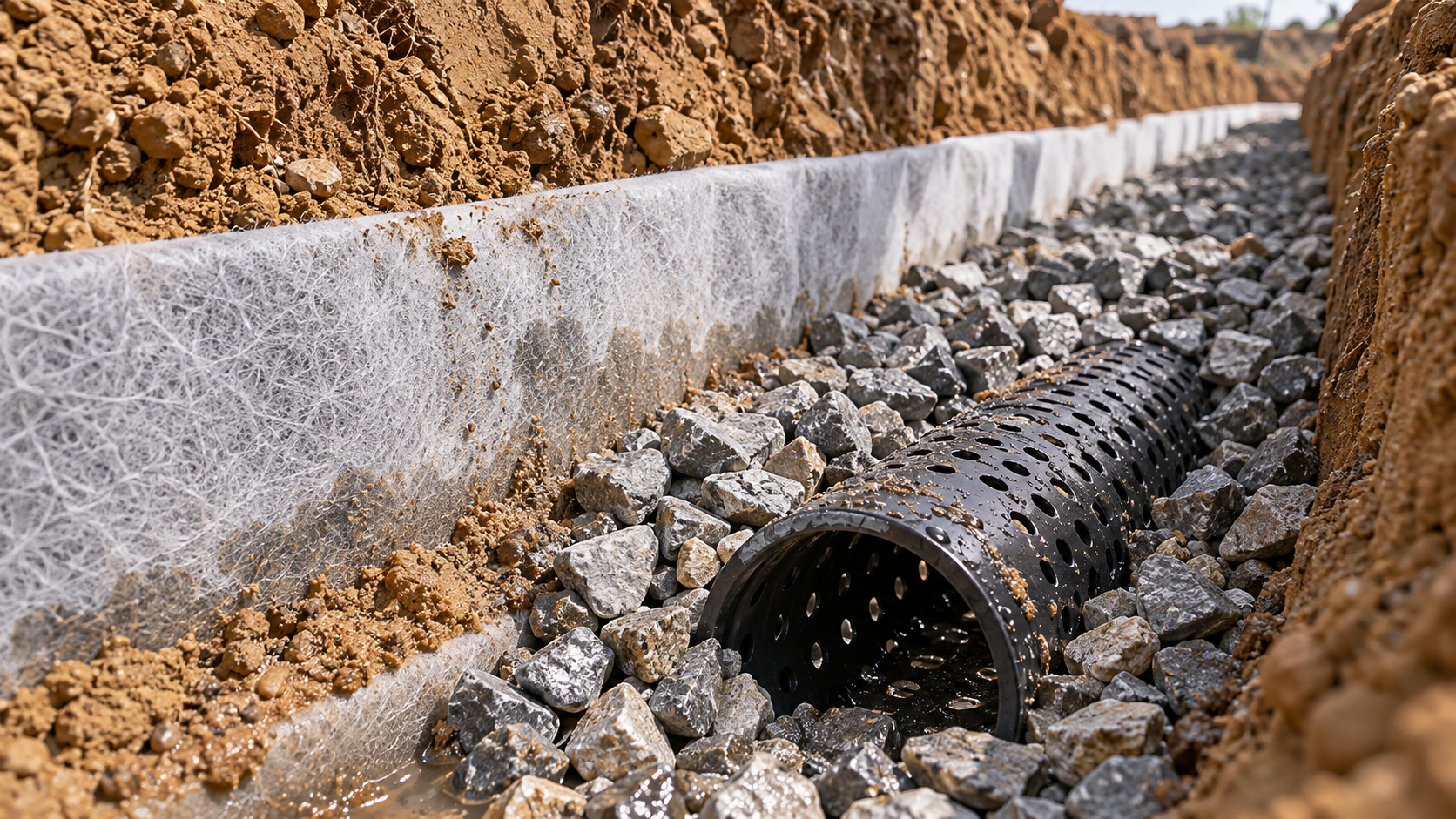
Why Geotextiles Clog in Drainage Systems and How to Prevent It
A drainage system can lose capacity long before its pipes fail when the geotextile filter becomes clogged. Geotextiles must retain soil while allowing water to pass, but incompatible openings, migrating fines, biological growth, and chemical precipitation can compromise that balance. Preventing failure requires more than comparing product datasheets: soil–filter compatibility, hydraulic performance under confinement, and installation conditions all matter.
The first practical distinction is between a blocked filter and a drainage system that cannot discharge. A submerged outlet, crushed pipe, inadequate gradient, or sediment-filled aggregate can produce similar symptoms. Replacing the fabric without locating the hydraulic restriction may leave the original problem untouched.
Where clogging actually develops
In a properly functioning filter, some initial soil movement can occur before a stable soil structure develops next to the geotextile. The objective is not to capture every particle immediately. It is to retain the soil skeleton while permitting sufficient flow without continuing erosion or progressive blockage.
Mechanical restriction develops in different locations. Blinding occurs when fine particles accumulate against the upstream face. Internal clogging occurs when particles enter and become trapped within the pore network. A low-permeability zone can also develop in the adjacent soil. These mechanisms can coexist, and their remedies are not necessarily the same.
For example, a trench drain through silty ground may experience sustained fine-particle delivery during wet periods. A fabric chosen simply because it has smaller openings may retain more of those fines at its surface, increasing head loss. Conversely, selecting a more open fabric without checking soil retention can allow continuing soil loss into the drainage aggregate. Neither “finer” nor “more permeable” is automatically safer.
Some deposits are not soil
Groundwater containing dissolved iron can form deposits when conditions change near a drain, particularly where oxygen becomes available. Carbonate precipitation may also occur under suitable water chemistry. Microbial growth and biofilms can restrict flow, especially where water contains nutrients or organic matter. These processes may affect the aggregate and pipe openings as well as the geotextile.
This matters in mine drainage, landfill-related systems, and groundwater interception works. A clean-water permeability result does not predict resistance to mineral deposition or biological fouling. If deposits are suspected, water analysis and inspection of recovered material are more useful than immediately changing the fabric weight.
Select for the soil, not the roll weight
Mass per unit area is useful for product identification and may relate to mechanical robustness within a particular product family. It is not a filtration design criterion by itself. Two geotextiles with similar weights can have different opening-size distributions, thicknesses, and hydraulic behavior.
Start with representative soil information from the actual filter interface. A broad description such as “sandy fill” is insufficient if the material includes variable silt seams or pockets of clay. Particle-size distribution, fines content, plasticity where relevant, and the possibility of internal instability all influence selection. Gap-graded soils deserve particular attention because smaller particles may migrate through the coarse skeleton toward the filter.
Evaluate retention and flow together. Apparent opening size, commonly measured using ASTM D4751, helps characterize openings for retention assessment. Water permeability normal to the plane, commonly evaluated under ASTM D4491/D4491M, provides hydraulic information. Neither test alone establishes long-term soil–geotextile compatibility.
Specifications may instead use characteristic opening size measured under ISO 12956 and normal-to-plane water permeability under ISO 11058. Results from different methods should not be treated as interchangeable without checking the procedures and reporting basis. For international procurement, agreeing on the test method is as important as agreeing on the numerical requirement.
Be equally cautious about blanket preferences for woven or nonwoven products. Needle-punched nonwovens offer a three-dimensional pore network; woven monofilament products can offer controlled openings and substantial open area. Suitability depends on the particular construction and soil conditions, not simply the manufacturing label.
Check the hydraulic condition the datasheet leaves out
A geotextile that passes water readily when clean and unconfined may behave differently beneath backfill or against a compressed drainage core. Confinement can change thickness and pore structure. Contact with soil introduces another source of head loss. Design therefore needs to consider the installed assembly rather than treating the fabric as an isolated sheet.
Keep normal-to-plane filtration separate from in-plane drainage. Water crossing a filter is a different hydraulic task from water traveling along a geocomposite drainage core. If the core compresses, the outlet backs up, or the available flow path is too long, selecting a higher-permittivity filter may not restore system capacity.
The design flow also needs context. Steady seepage behind a retaining wall differs from storm-driven inflow, reversing flow, or rapid drawdown. Changing gradients can disturb soil particles and alter the filter interface. Where the consequences of failure are significant, these conditions justify project-specific evaluation rather than reliance on a generic drainage detail.
When compatibility testing is worth the effort
Laboratory soil–geotextile testing is particularly useful for variable or internally unstable soils, high fines contents, unusual water chemistry, and inaccessible drainage systems. A gradient-ratio test, such as ASTM D5101 where applicable, evaluates hydraulic behavior across a soil–geotextile system. Its suitability and test conditions should be confirmed with the laboratory, especially for low-permeability soils.
Ask for more than a final pass/fail statement. Flow and head-loss trends help distinguish a system approaching stable filtration from one developing increasing resistance. Continuing soil loss also matters: high flow is not a success if the filter is allowing progressive erosion. Test duration, hydraulic gradient, soil preparation, and water chemistry should reflect the problem being investigated.
Installation can defeat a sound filter design
A common avoidable mistake is placing clean drainage aggregate beside a muddy excavation and then wrapping it with fabric already coated in slurry. The filter begins service with a contamination layer that the design never anticipated. Another is allowing dirty runoff into an open drain before the surrounding works are stabilized.
Installation controls should address the actual routes by which contamination and damage occur:
- Keep rolls protected from mud, damage, and prolonged exposure beyond the manufacturer's storage guidance.
- Prepare the contact surface so the fabric lies against the soil without bridging voids or stretching across sharp projections.
- Use drainage aggregate meeting the specified grading and cleanliness requirements; aggregate fines can create their own blockage.
- Complete overlaps, seams, and terminations according to the design so soil cannot bypass the filter.
- Control construction runoff and place cover carefully, avoiding direct equipment traffic on exposed fabric.
Filter location deserves attention too. A sock around a perforated pipe is not automatically equivalent to a filter around the boundary of a drainage trench. With a pipe sock alone, fines may first enter and contaminate the surrounding aggregate. The required filtration boundary should be established in the drainage detail, not improvised during installation.
Investigate declining flow before choosing a repair
Low outlet flow does not prove clogging; the groundwater supply may simply have fallen. More informative evidence is rising upstream water level accompanied by reduced discharge under comparable conditions. Inspection points, piezometers where appropriate, and accessible cleanouts make that distinction easier.
Check outlet condition and pipe continuity before excavating the filter. If investigation reaches the geotextile, record the location and appearance of deposits, inspect the aggregate, and retain representative samples. Surface sediment, particles embedded within the fabric, and mineral crusts point toward different mechanisms, although appearance alone may not establish the cause.
Flushing may remove sediment from an accessible pipe, but it should not be assumed to regenerate a buried filter. Aggressive jetting can disturb adjacent soil or damage components. Chemical cleaning requires additional caution because of polymer compatibility, worker exposure, and discharge requirements. Where groundwater chemistry presents a persistent fouling risk, maintainable collection arrangements may be more practical than depending on a permanently buried filter.
Make the specification verifiable before shipment
For overseas supply, technical intent must survive product substitution, documentation review, and site receiving. Shandong Hongyun Special Hose Co., Ltd. supplies geotextiles and geomembranes for international infrastructure and environmental projects. In that procurement context, a defined material grade and project-specific acceptance requirements are more useful than an order described only as “heavy-duty drainage fabric.”
Confirm the specified opening-size method, hydraulic properties, installation-survivability requirements, and supporting test documentation before dispatch. Clarify whether submitted values are typical results or specified acceptance values, and establish roll identification and traceability. Export packaging should protect the material through the expected transport and storage conditions. Trade terms such as FOB or CIF do not settle technical acceptance criteria.
Before approving a geotextile for drainage, ask three questions: can it retain this soil without progressive erosion, can the installed system pass the required flow, and can predictable fouling be inspected or managed? If any answer depends only on fabric weight or a clean-water datasheet, the evaluation is not finished.
Related Posts
Contact Us
Leave A Message
If you are interested in our products and want to know more details, please leave a message here, we will reply you as soon as we can.