
Using Geosynthetics to Reduce Aggregate Demand in Roads on Soft Subgrades
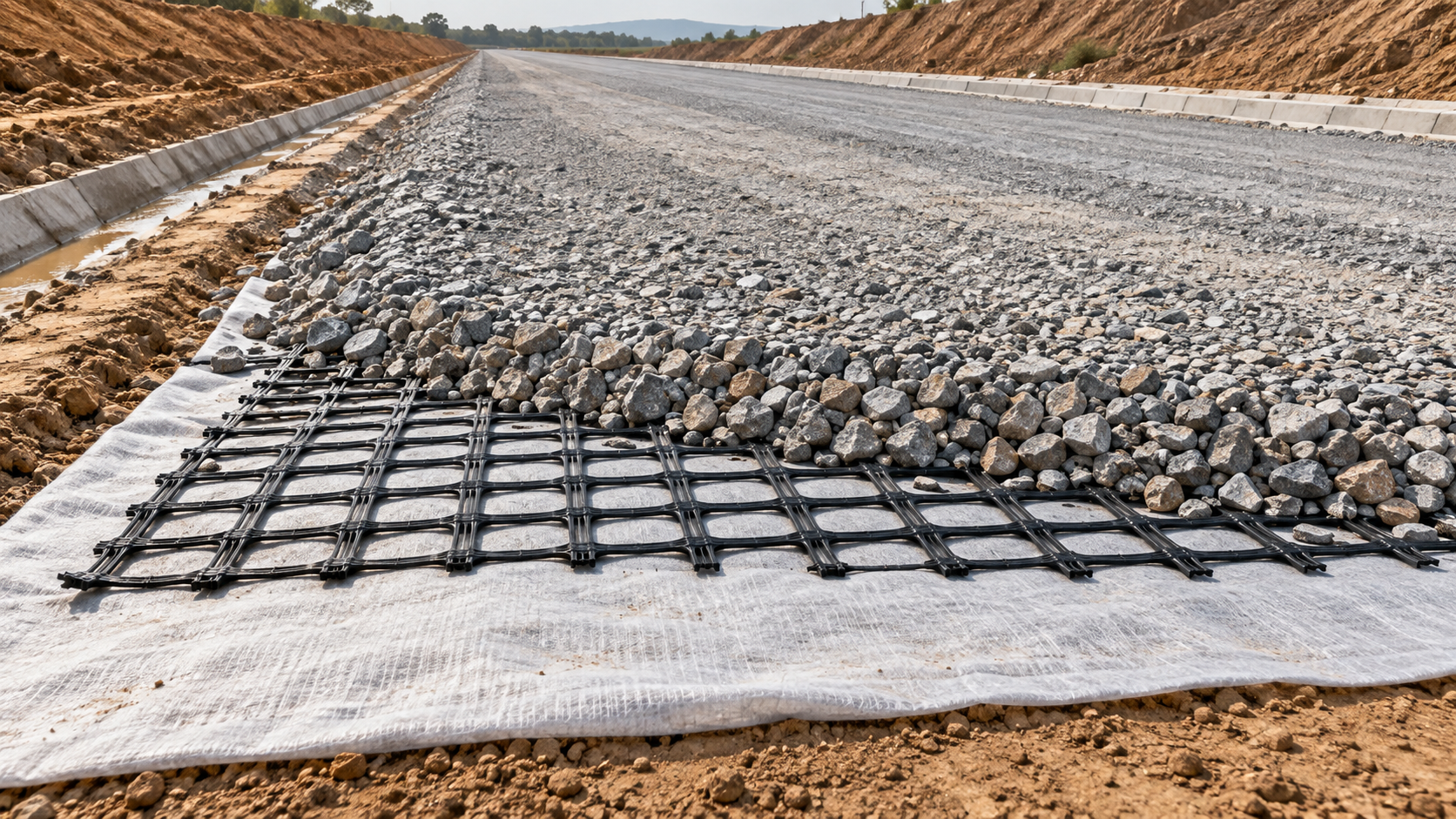
Geosynthetics can reduce aggregate demand on soft-subgrade roads, but they do not justify a blanket reduction in layer thickness. The strongest opportunity arises when a properly selected geotextile preserves aggregate by preventing contamination, or when a geogrid provides stabilization that is explicitly recognized by a suitable design method. Neither function removes the need to check bearing capacity, rutting, drainage, and construction traffic.
The distinction matters commercially: preserving the effectiveness of a granular layer is not the same as proving that a thinner layer will perform adequately. A defensible solution compares reinforced and unreinforced designs under the same loading, ground conditions, and performance requirements—and confirms that the reduced section can survive installation as well as service.
Identify why the road is consuming aggregate
On a weak formation, additional stone may be addressing several different problems. Aggregate can penetrate the subgrade under wheel loads, while fine soil migrates into the granular layer. The resulting mixed zone no longer behaves like clean, compacted aggregate. More material is then placed to restore running level, without necessarily resolving the mechanism causing deterioration.
A separate problem is lateral displacement. Granular particles spread under repeated loading, allowing wheel-path depressions to develop. On very weak ground, the subgrade itself may deform or fail in shear. These mechanisms can occur together, but they require different responses.
Before selecting a geosynthetic, distinguish between:
- Loss of separation: aggregate and subgrade mix, reducing the useful thickness of the granular layer.
- Insufficient granular restraint: particles move laterally and permanent deformation accumulates.
- Inadequate foundation support: the soil cannot carry the applied load without unacceptable deformation.
- Water-related weakening: saturation, trapped water, or poor drainage reduces the support available during construction or service.
This diagnosis prevents a common specification error: selecting a high-strength material without establishing which failure mechanism it must control. A strong geotextile is not automatically an effective filter, and a geogrid cannot independently stop fine soil migrating through its apertures.
Match the material to the mechanism
Geotextiles preserve the granular layer
A geotextile placed between the subgrade and aggregate creates a separation interface. Its role is to limit intermixing while allowing water movement appropriate to the soil and drainage arrangement. This helps the placed aggregate retain its intended grading and mechanical function.
Selection therefore requires more than mass per unit area. Relevant properties include soil retention, water permeability, clogging resistance, and resistance to puncture and installation damage. The fabric must survive placement of the specified aggregate on the actual formation, not merely meet a tensile-strength value on a data sheet.
Both woven and nonwoven geotextiles can serve separation applications when appropriately specified. Their suitability depends on measured properties and site requirements rather than the manufacturing category alone. For fine-grained or difficult soils, filtration compatibility deserves particular attention.
Separation can reduce aggregate lost into the formation and the need for corrective topping-up. However, this benefit should not automatically be converted into a structural thickness reduction. Where the design method provides no such credit, the defensible benefit is preservation of the designed section.
Geogrids restrain aggregate movement
Geogrids interact with aggregate through their apertures and ribs. With compatible aggregate, adequate compaction, and suitable confinement, that interaction can restrict lateral particle movement and improve the response of the granular layer under traffic.
The useful performance is therefore a property of the aggregate–geogrid system, not of the grid in isolation. Aperture geometry, rib and junction behavior, aggregate grading, particle shape, and placement conditions all influence the result. Ultimate tensile strength alone is an inadequate basis for predicting road stabilization performance.
Reinforcement can also develop through tension as a geosynthetic deforms. However, mechanisms that require substantial deformation must be treated carefully where rut limits are tight. A road cannot rely on large rut formation to mobilize reinforcement if that rutting would already make it unacceptable for use.
Where both mixing and lateral movement are concerns, a geogrid with a separate geotextile, or a suitable composite, may be appropriate. The combined arrangement still requires verification: component placement and interface interaction affect performance, and benefits should not simply be added together.
Establish the conditions that control thickness
A reliable assessment starts with subgrade characterization along the alignment. A single average strength value can conceal short weak sections that govern construction access and local failure. Investigation should identify changes in soil type, moisture condition, groundwater, and the depth of weak deposits.
California Bearing Ratio, undrained shear strength, and other support measurements are not interchangeable inputs. The selected design method determines which properties are needed and how they should be established. Laboratory results must also represent the moisture and density conditions expected in the field, including seasonal weakening where relevant.
Traffic assumptions need equal scrutiny. A temporary access road may accept maintenance and some rutting, whereas a permanent paved road requires control of deformation beneath the pavement. Construction vehicles may impose heavier axle loads or more severe localized loading than the eventual users. Turning areas, loading points, steep approaches, and repeated wheel paths can govern performance even when total traffic is modest.
Aggregate quality remains fundamental. Weak, degradable, poorly graded, or highly plastic material cannot be treated as equivalent to a durable granular layer because reinforcement is present. A change of quarry source can also change particle shape and grading enough to require reassessment of the proposed system.
Drainage must be resolved independently. A permeable geotextile is not, by itself, a drainage system: water still needs an outlet. Crossfall, side drains, formation level, and groundwater control determine whether the road foundation remains serviceable.
Reduce thickness only through a defined design comparison
The starting point should be an unreinforced section that satisfies the required traffic and performance criteria. The geosynthetic alternative should then be evaluated using an accepted design approach appropriate to the road type, soil conditions, and proposed material.
The comparison must hold the principal assumptions constant. A thinner reinforced section is not a valid saving if it is assessed against fewer vehicle passes, lighter axles, better subgrade conditions, or a greater allowable rut depth than the reference design.
Evidence supporting a reduction should also match the proposed application. Results from an unpaved trafficking trial do not automatically establish the structural contribution required in a permanent paved road. Likewise, performance demonstrated with one aggregate grading or geogrid configuration should not be assumed to apply to materially different combinations.
Before approving a reduced section, the design record should establish:
- The reference and proposed layer thicknesses, with aggregate properties defined.
- The subgrade design condition and treatment of weaker sections.
- Traffic loading, design life or pass count, and allowable deformation.
- The geosynthetic function and the evidence supporting any design credit.
- The minimum cover and construction procedure required to protect the material and formation.
The controlling thickness may be the construction minimum rather than the calculated service requirement. A section that could perform under normal traffic may still be too thin to support spreading and compaction equipment without damaging the interface.
Deep compressible soils introduce another limit. A stabilized granular platform may improve access and distribute near-surface loading, but it does not eliminate consolidation settlement in underlying soft deposits. Where settlement or global stability governs, ground improvement, staged construction, or another foundation solution may be necessary.
Protect the design benefit during installation
Installation is part of the engineering solution. Damage, misplaced overlaps, unsuitable aggregate, or uncontrolled trafficking can remove the benefit assumed in the design before the road opens.
The formation should be prepared to the specified condition without unnecessary disturbance. Repeated trafficking or aggressive trimming of wet soil can weaken it further. Standing water, sharp objects, and localized unstable areas require assessment before covering; concealing them beneath fabric does not resolve the underlying problem.
Rolls should be laid with the specified orientation, overlap or connection arrangement, and sufficient restraint to avoid displacement during spreading. Overlap requirements depend on the material, subgrade condition, and construction method. A generic overlap copied from another project is not a substitute for an installation detail.
Aggregate placement should follow an approved sequence, generally advancing over previously placed material rather than allowing trucks to run directly on the exposed geosynthetic. Dumping and spreading must avoid dragging, folding, or overstressing the material. Sharp turns and hard braking over thin initial cover deserve particular control.
Compaction equipment and procedures must suit the available support. If rolling produces progressive rutting, pumping, or visible movement, additional passes are not necessarily improving density. Work should stop for assessment of moisture, layer thickness, equipment loading, and formation stability.
A trial section can help verify constructability before full production. It should use the proposed aggregate, equipment, placement sequence, and representative weak ground. Acceptance criteria need to be agreed beforehand; surviving a few vehicle passes does not establish long-term structural performance.
Calculate savings from the approved section, not a headline percentage
Aggregate savings should be quantified only after the alternative design is accepted. For a constant-width road, the theoretical compacted-volume reduction is road length multiplied by width and the approved thickness reduction.
For illustration, a 1,000 m road with a 6 m treated width and an approved reduction of 0.10 m would require 600 m³ less compacted aggregate. This is a geometry calculation, not a predicted geosynthetic benefit. Conversion to purchased tonnage requires the project’s density and quantity basis, with allowances for compaction, handling, and losses.
The cost comparison should include delivered aggregate, placement and compaction, geosynthetic supply, freight, overlaps, cutting waste, installation, and quality assurance. Where excavation and disposal are genuinely avoided, those savings can be included. Where the road level is fixed by drainage or tie-ins, the consequences of changing the section must be checked.
Reduced truck movements may ease access constraints and shorten aggregate placement, but programme savings depend on actual sequencing. They should not be counted where geosynthetic delivery, formation preparation, testing, or other activities control the critical path.
Keeping the original aggregate thickness can also be a rational choice. Where subgrade variability is high or maintenance access is difficult, using geosynthetics to preserve the full section may offer more value than pursuing the maximum theoretical material reduction.
Make acceptance specific to the road system
Procurement and site acceptance should preserve the assumptions behind the design. Roll identification, relevant test reports, specified material properties, and installation records provide traceability. Substitution based solely on product weight or ultimate tensile strength can invalidate the basis for the reduced section.
The decisive approval is therefore not simply that a geosynthetic meets its product specification. It is that the installed system—subgrade, geosynthetic, aggregate, drainage, and construction method—matches the conditions used to justify the design.
Where that link is demonstrated, reduced aggregate demand can be an engineered outcome rather than a commercial assumption. Where it is not, retaining the required granular thickness and using geosynthetics for separation or stabilization is the more defensible decision.
Related Posts
Contact Us
Leave A Message
If you are interested in our products and want to know more details, please leave a message here, we will reply you as soon as we can.