
What Are Geosynthetics Used for in Roads, Drainage, and Containment?
What Are Geosynthetics Used for in Roads, Drainage, and Containment?
Geosynthetics help roads withstand traffic, drainage systems manage water, and containment facilities limit leakage—but these applications require different materials. Geotextiles can separate soil layers and filter water, geogrids reinforce aggregate and soil, and geomembranes provide low-permeability barriers for ponds, landfills, and industrial facilities.
The useful starting point is not “Which roll should we buy?” It is “What must this layer do?” A fabric that works well beneath drainage stone may not provide the reinforcement needed over weak ground. A liner that resists a stored liquid may still be vulnerable to puncture during installation. Understanding those distinctions helps avoid specifications that look reasonable on paper but leave the actual site problem unresolved.
Different materials solve different ground problems
Geosynthetics are manufactured materials used with soil, rock, or other construction materials to perform engineering functions. Most familiar products are polymer-based, although some systems combine polymers with mineral components. Their appearance can be misleading: two black rolls may have entirely different hydraulic and mechanical properties.
- Geotextiles are permeable fabrics used for separation, filtration, protection, and, in some designs, reinforcement. Woven and nonwoven products should be selected by their measured properties rather than their names alone.
- Geogrids have open apertures and are used to reinforce soil or aggregate. Their effectiveness depends on interaction with the surrounding material, not simply on tensile strength.
- Geomembranes are very low-permeability sheets used as barriers. HDPE and LLDPE are common options, but material selection depends on exposure, deformation, chemical compatibility, and construction conditions.
- Geonets and drainage geocomposites provide in-plane flow paths. A geocomposite may combine a drainage core with filter geotextiles.
- Geosynthetic clay liners typically contain bentonite held between or bonded to geosynthetic layers. Their barrier performance depends on conditions including hydration, confinement, and liquid chemistry.
These products are frequently used together. A containment system, for example, may need a geomembrane for the barrier, a geotextile for cushioning, and a drainage composite above or below it. None is an automatic substitute for the others.
In roads, keeping layers separate can be as important as reinforcement
Consider an access road built over wet, fine-grained soil. Aggregate is placed, construction trucks start moving, and the underlying soil begins mixing into the stone. As contamination progresses, the aggregate layer can lose drainage capacity and become less effective at distributing loads.
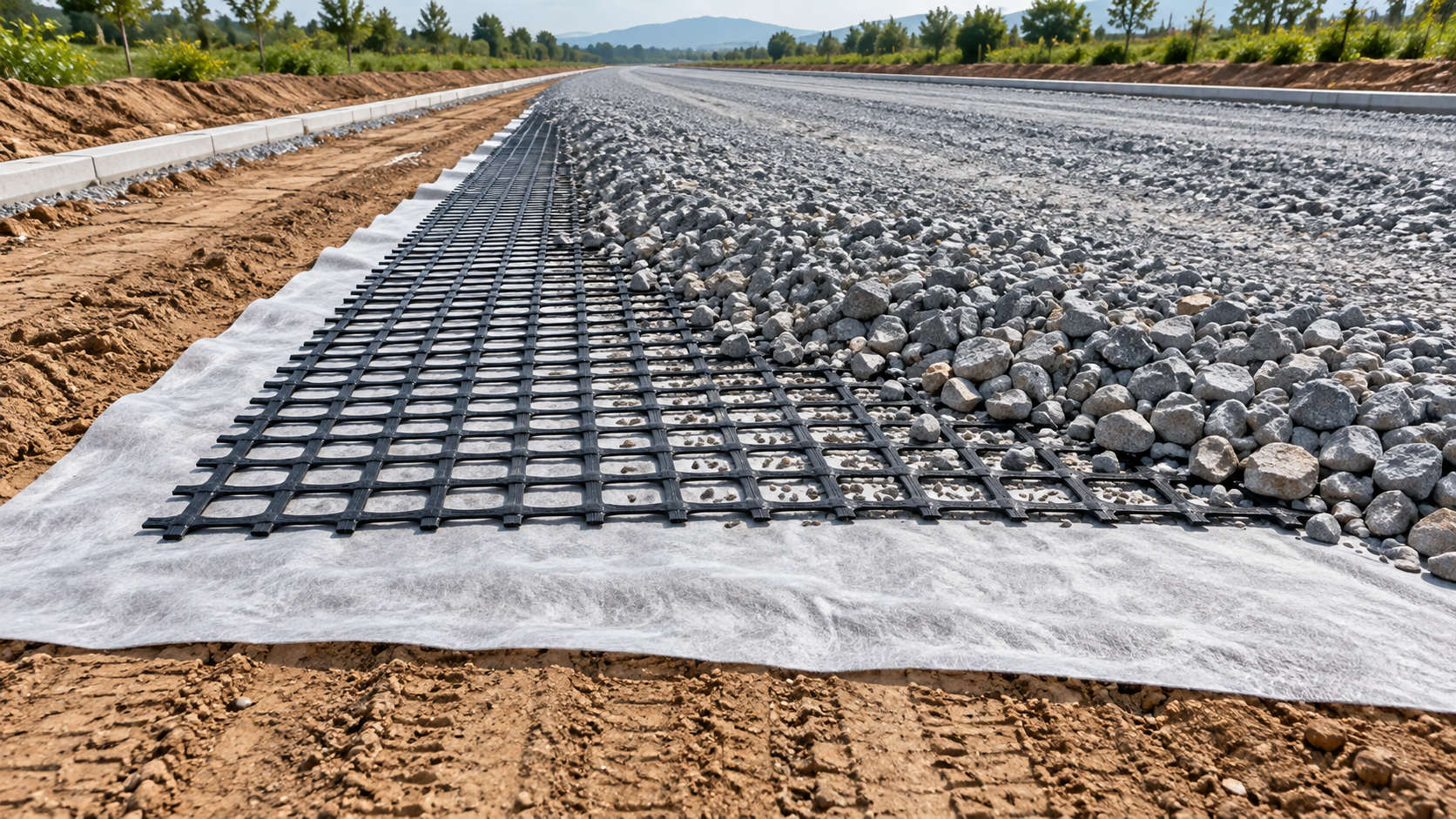
A separation geotextile at the soil–aggregate interface helps prevent that mixing while allowing water to pass. It preserves the function of the constructed layers; it does not turn the underlying soil into competent ground. Very soft subgrades may still require additional treatment, thicker working platforms, staged construction, or a separately designed reinforcement system.
Where geogrids fit
Geogrids are used in road foundations to restrain aggregate movement and improve load distribution through interaction with the granular layer. Aperture geometry, aggregate grading, junction properties, and installation conditions all influence performance. Selecting a grid by its quoted tensile strength alone misses much of what happens within the road structure.
Some designs combine a geogrid with a separation geotextile where both reinforcement and control of soil migration are needed. Whether that arrangement permits a thinner aggregate layer must be established through an accepted design method and project-specific inputs—not assumed from a general product claim.
Installation deserves equal attention. Wrinkles, unsuitable overlaps, insufficient initial cover, and direct trafficking on exposed material can compromise the intended function. The initial aggregate placement is often the critical stage because construction equipment applies loads before the full pavement structure exists.
Geosynthetics also appear in reinforced road embankments, retaining structures, and pavement rehabilitation. These are distinct design applications. A product specified for subgrade separation should not be assumed suitable for reinforcing an embankment or controlling cracking in an asphalt overlay.
In drainage, water must move without taking the soil with it
A drainage system has two jobs that can conflict: admit water and retain surrounding soil. If the filter openings are unsuitable, soil particles may migrate into the drain. If the filter is too restrictive or becomes clogged, water pressure can build behind it.
Geotextiles commonly perform this filtration role around drainage trenches, behind retaining walls, beneath erosion-control stone, and within subsurface drainage systems. Selection requires information about the adjacent soil, including particle-size distribution and, where relevant, its tendency to disperse or clog a filter.
Mass per unit area is not a filtration specification. A heavier fabric is not automatically better, and two products with similar weights may have different opening sizes and water-flow characteristics. Relevant properties include characteristic opening size, cross-plane water flow, and resistance to damage during placement. Testing terminology and methods should match the project specification.
Drainage capacity changes under pressure
Where a geocomposite replaces part of a granular drainage layer, water travels along its core toward an outlet. Its usable flow capacity depends on the compressive load, hydraulic gradient, contact surfaces, and long-term behavior. A value measured under light laboratory loading may not represent performance beneath a deep fill.
Designers therefore consider effects such as core compression, creep, geotextile intrusion, and clogging. Connections and outlets matter just as much: a drainage sheet that ends at a blocked pipe or an unconnected edge cannot relieve water pressure as intended.
A useful distinction is that filtration usually concerns water passing through a material, while drainage concerns water moving along a flow path. Some products contribute to both, but those functions should be checked separately.
Containment depends on the complete liner system
Geomembranes are used in landfill lining and capping, wastewater ponds, process-water storage, mining facilities, and other installations where seepage must be controlled. The required arrangement depends on the stored material, environmental consequences, ground conditions, and applicable project or regulatory requirements.
“Waterproof sheet” is an inadequate description for these applications. The design must address chemical resistance, stress cracking where relevant, anticipated strain, temperature, exposure, puncture risk, and seam quality. Nominal thickness is important, but it is only one part of that assessment.
HDPE is commonly considered where chemical resistance and welded barrier construction are priorities. LLDPE may be considered where greater flexibility and strain accommodation are needed. Neither statement makes one polymer universally preferable. Actual formulations, liquid composition, operating temperature, and expected deformation need review.
The supporting surface must also be suitable. Sharp stones, poorly compacted areas, and abrupt changes in geometry can create local stresses. A protection geotextile may reduce puncture risk, but it cannot make an inadequately prepared foundation acceptable.
Seams, penetrations, and slopes need particular care
Large liners are assembled from multiple panels, making field seams part of the barrier itself. Installation planning should include seam procedures, trial welds, inspection, appropriate nondestructive testing, destructive testing where specified, and documented repairs. Pipe penetrations and connections to concrete structures deserve specific details rather than improvised sealing on site.
On slopes, interface stability can govern the design. Soil, smooth or textured geomembranes, geotextiles, and drainage composites develop different interface shear resistance. Texturing may help in a particular arrangement, but stability should be checked using representative materials and relevant loading conditions.
Some facilities use composite barriers, leak-detection layers, or multiple liners. These arrangements should follow the design and applicable requirements; they are not universal features of every pond or containment facility.
What should you check when comparing options?
Begin with a short description of the site problem and the intended function. “Separate wet subgrade from road aggregate” is a much more useful starting point than “supply heavy-duty fabric.” The former identifies what must be demonstrated; the latter leaves too much open to interpretation.
Then connect the specification to the conditions the material will actually experience:
- Ground and water: soil grading, bearing conditions, groundwater, hydraulic gradients, and drainage outlets.
- Loads and movement: construction traffic, permanent loading, settlement, and slope geometry.
- Exposure: stored liquids, temperature, sunlight before covering, and anticipated service conditions.
- Acceptance evidence: agreed test methods, required property limits, batch traceability, inspection records, and installation documentation.
Compare results only when test methods and conditions are compatible. Index tests support material identification and quality control; they do not necessarily demonstrate performance in the proposed system. Depending on the application, soil–filter compatibility, interface shear, chemical compatibility, or loaded drainage testing may need separate assessment.
Delivery details can affect installation quality
For international projects, roll dimensions, unloading arrangements, packaging, labeling, and document availability are practical engineering concerns. A roll that cannot be handled safely with the available equipment creates problems before installation begins. Poor identification also makes it harder to connect installed panels with their manufacturing records.
Shandong Hongyun Special Hose Co., Ltd. supplies geomembranes and geotextiles alongside industrial hoses for overseas infrastructure and environmental applications. Its support for specified material grades, export packaging, FOB or CIF arrangements, and project documentation is relevant to this coordination. However, trade terms and shipping documents do not replace technical acceptance: material requirements, verification records, and installer responsibilities still need agreement before dispatch.
The central distinction remains straightforward: roads need stable, compatible layers; drains need controlled water movement; containment needs a continuous, protected barrier. Identify that function first, then check the material and its interfaces against real site conditions. The right product is the one that performs within the constructed system—not simply the strongest, thickest, or heaviest roll available.
Related Posts
Contact Us
Leave A Message
If you are interested in our products and want to know more details, please leave a message here, we will reply you as soon as we can.