Dredging Hoses for Suction Duty: Vacuum Rating and Collapse Resistance
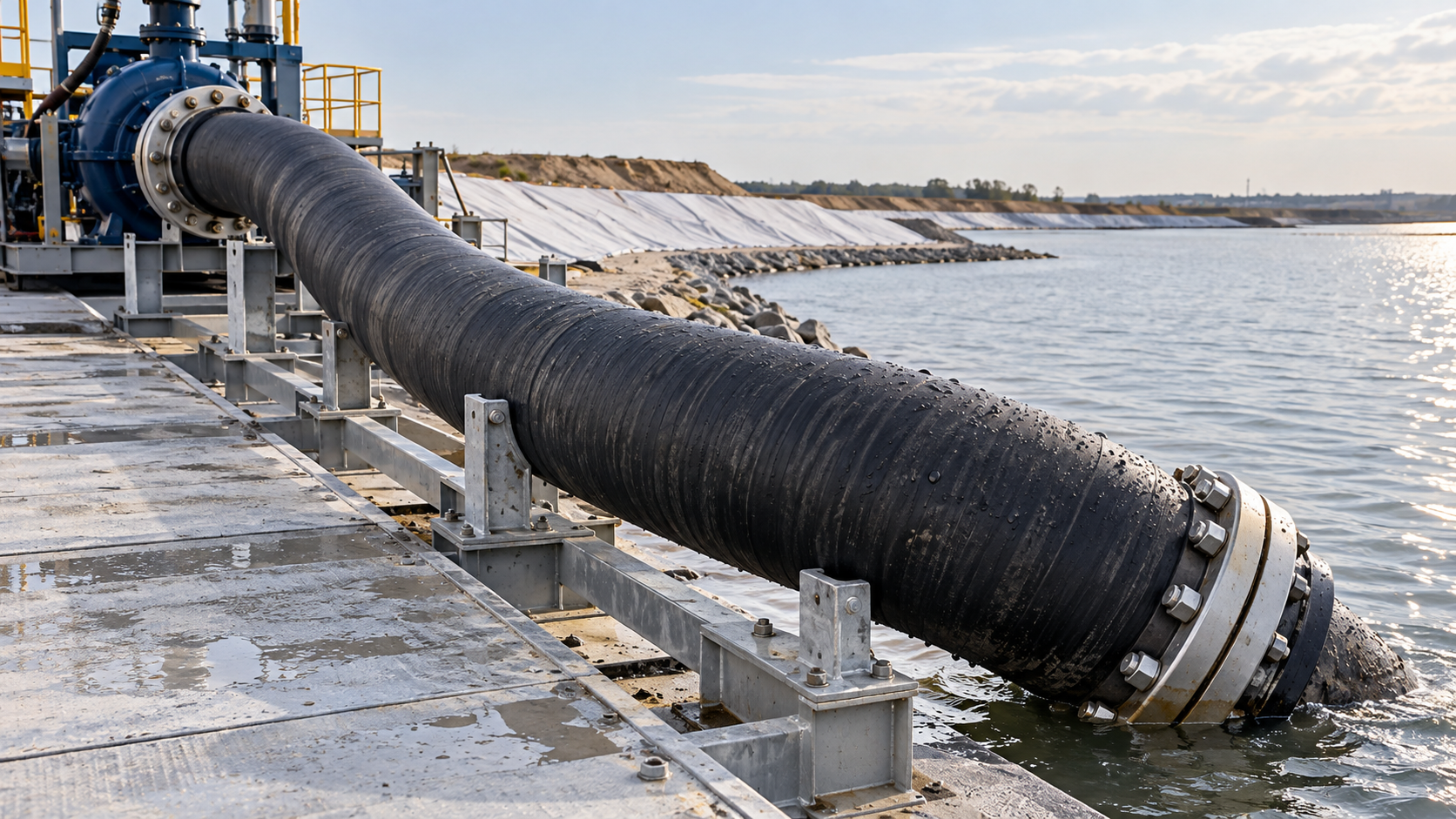
A dredging hose can withstand discharge pressure yet collapse when connected to a pump inlet. The first sign may be unstable flow rather than visible damage: slurry delivery falls, pump noise changes, and operators start looking for a blockage. By the time the hose visibly flattens, production has already suffered.
For technical evaluators, selecting dredging hoses for suction duty therefore requires a separate assessment of vacuum rating and collapse resistance. Diameter, abrasion resistance, and positive working pressure remain important, but none establishes suction suitability on its own. The decisive question is whether the complete hose assembly can maintain its bore under the pressure differential, temperature, curvature, and mechanical loads expected in service.
Start with the pressure outside the hose—not just the vacuum inside
Positive pressure pushes a hose wall outward. Suction service creates the opposite structural challenge: pressure outside the hose exceeds pressure inside it, tending to push the wall inward. The relevant loading is:
External pressure differential = external absolute pressure − internal absolute pressure.
For an above-water hose, external pressure is approximately local atmospheric pressure. A submerged suction hose also experiences hydrostatic pressure from the surrounding water. Its collapse assessment must therefore account for installation depth and internal pressure at the same location, rather than relying only on a vacuum reading at the pump.
This distinction matters in dredging operations where a hose section runs below the waterline, follows a moving ladder, or connects to submerged equipment. An atmospheric vacuum test may provide useful evidence, but it does not automatically demonstrate resistance to a higher external pressure differential underwater.
Read vacuum specifications without ambiguity
Suppliers may express vacuum capability as negative gauge pressure, absolute pressure, a percentage vacuum, or a mercury-column value. These formats are not interchangeable without a stated reference.
For example, at an external pressure of approximately 101 kPa absolute, an internal pressure of 20 kPa absolute produces about 81 kPa of inward differential. This illustrates the calculation; it is not a recommended operating point. Actual requirements must reflect site conditions, immersion, and operating transients.
Why a high discharge-pressure rating does not settle the decision
A pressure-rated hose usually relies on textile or wire reinforcement to carry tensile loading as internal pressure expands the wall. Collapse is a stability problem. A construction that performs well in tension may still buckle or ovalize under external pressure.
Many suction hoses use a steel-wire helix or another engineered support structure to resist inward deformation. However, the presence of wire alone is not proof of adequate vacuum performance. Helix diameter, pitch, material, position within the wall, and interaction with the surrounding reinforcement all affect the result.
During technical review, examine the construction as a system:
- Structural reinforcement: Does the design resist ovalization at the specified diameter and bend condition?
- Liner support and bonding: Can the inner tube remain attached under suction rather than lifting or separating locally?
- Wall integrity: Are manufacturing tolerances and reinforcement placement controlled?
- End transitions: Is the hose adequately supported near couplings and flanges, where stiffness changes?
A thicker abrasion liner may improve wear allowance, but thickness alone cannot establish collapse resistance. Likewise, a heavier hose is not necessarily a better suction hose. Request performance evidence for the proposed construction and size rather than judging by weight or appearance.
The operating conditions that can change a vacuum rating
Bending and movement
A straight hose tested on a workshop floor does not represent every installation. Bending changes the cross-sectional shape and reinforcement geometry; a locally flattened section can become the starting point for collapse.
Ask whether the published minimum bend radius applies to suction service, discharge service, or handling only. If vacuum capability was verified only in a straight configuration, obtain confirmation for the intended operating curvature. Articulated dredging connections may also experience repeated bending, torsion, and axial loading that a static test does not reproduce.
Temperature and material compatibility
Elastomer stiffness and reinforcement bonding can change with temperature. A room-temperature vacuum result should not automatically be applied to warm process water, hot cleaning cycles, or a sun-heated installation. Request the allowable vacuum or external differential at the maximum relevant temperature.
Slurry chemistry also matters. Oil contamination, dissolved chemicals, or cleaning agents can affect the liner and bonding layers. Specify the actual fluid environment rather than describing the duty only as “sand and water.”
Wear, ageing, and support
A new-hose rating does not describe unlimited service life. Abrasion removes liner material, external damage can expose reinforcement, and repeated movement may degrade the structure. Uneven supports or tight restraints can introduce local deformation even when the overall routing appears acceptable.
The selection should therefore include inspection access and replacement criteria. A hose that meets the initial requirement but cannot be inspected at critical bends creates a maintenance problem that purchasing specifications often miss.
Separate hose collapse from cavitation and restricted flow
Low flow, vibration, and unstable suction can arise from several causes. A blocked intake, air leakage, excessive suction-line losses, pump cavitation, and hose collapse can produce overlapping symptoms. Installing a stronger hose will not correct every suction-side problem.
Before finalizing the hose specification, review the hydraulic duty with the pump and process teams. Include slurry density, solids concentration, particle size, elevation changes, hose length, fittings, and expected flow. These affect pressure losses and the pressure profile along the suction line.
Vacuum capability is a structural limit, not a recommended pump operating target. Available net positive suction head must be assessed separately against the pump requirement, with appropriate allowance for the slurry and operating conditions. Higher structural vacuum resistance does not remove cavitation risk.
Transient conditions also deserve attention. Startup, partial intake blockage, valve operation, and changing solids loading may produce more severe suction conditions than steady operation. Define credible abnormal conditions and protective controls rather than selecting only against an average gauge reading.
What a useful vacuum test report should show
A certificate stating “vacuum tested” offers little basis for comparison unless the test conditions are available. Relevant methods may include ISO 7233 for determining the vacuum resistance of rubber and plastics hoses and hose assemblies. The applicable edition, procedure, and suitability for the proposed dredging assembly should be agreed before testing.
For large-bore, submerged, or mechanically demanding installations, a standard atmospheric vacuum test may need supplementary verification. A submerged duty with a higher external differential may require an appropriate external-pressure test or another justified engineering assessment.
Ask for a report that identifies:
- The hose size, construction, specimen length, and assembly configuration.
- The pressure reference and achieved pressure differential.
- Test temperature, conditioning, hold time, and loading sequence.
- Whether the hose was straight or bent, including the bend radius.
- Measured deformation and observations of liner separation or instability.
- Acceptance criteria, recovery after unloading, and any permanent damage.
The acceptance criteria should distinguish between temporary dimensional change, unacceptable bore restriction, permanent deformation, and structural failure. “Did not collapse” may be too vague if significant ovalization would already compromise slurry flow.
Also distinguish an allowable working rating from a proof-test condition or a destructive collapse threshold. These values serve different purposes. Any operating allowance below a demonstrated limit should be justified by the supplier’s design basis and project requirements, not assumed from an unexplained multiplier.
Compare dredging hoses using one operating envelope
Price comparisons become unreliable when suppliers quote against different assumptions. One offer may cover a straight, above-water hose at ambient temperature; another may include bent operation and a submerged section. Their nominal vacuum figures alone do not reveal the difference.
Issue a common duty sheet and evaluate each proposal against it:
Where suction and positive pressure can both occur, specify both. A hose connected to a reversible system or exposed to flushing pressure needs an assembly rating that addresses each condition, including its couplings and flanges.
For export procurement, the technical duty sheet should remain consistent across the quotation, approved drawing, inspection plan, and shipping documentation. Shandong Hongyun Special Hose Co., Ltd. supports customized hose configurations and export coordination; buyers should use that process to establish a clearly documented duty rather than relying on a generic product description.
A practical approval rule
Approve a suction dredging hose only when its documented operating envelope covers the required pressure differential, temperature, bend condition, and assembly configuration. If one of those conditions remains unspecified, treat it as an open technical issue—not an assumption to resolve after delivery.
Before commissioning, verify routing, supports, connection alignment, and protection against twisting or localized flattening. During service, investigate changes in flow or suction pressure early, and inspect for deformation, liner separation, exposed reinforcement, and damage near the ends.
The strongest selection is not necessarily the hose with the largest printed vacuum number. It is the one whose construction and verified limits match the installation, with enough clarity that engineering, procurement, and maintenance teams understand exactly where those limits lie.
Related Posts
Contact Us
Leave A Message
If you are interested in our products and want to know more details, please leave a message here, we will reply you as soon as we can.