
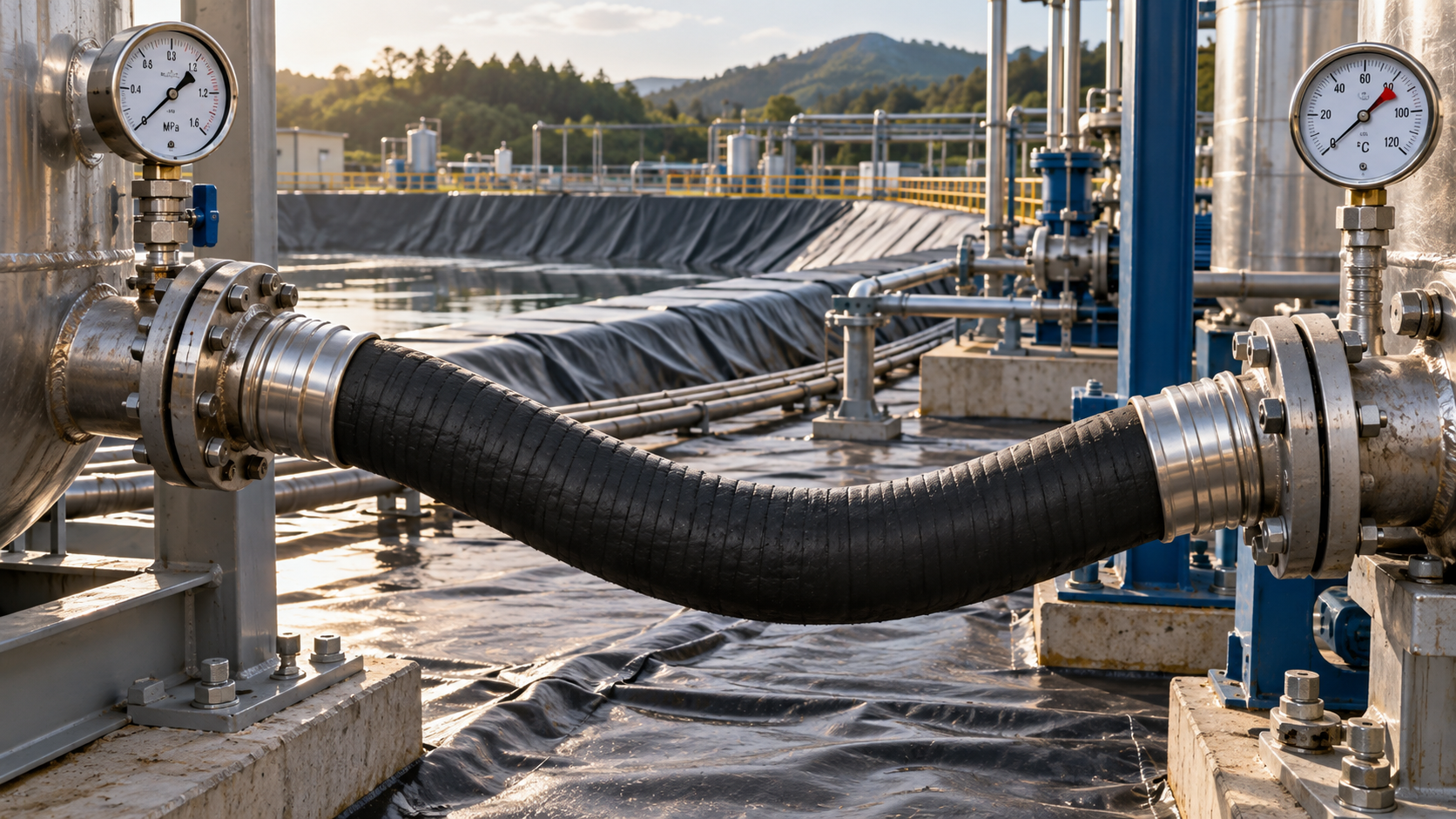
High operating temperatures can reduce the allowable working pressure of industrial hoses, making room-temperature ratings an unreliable basis for selecting elevated-temperature fluid-transfer equipment.
For technical evaluators in mining, petrochemical processing, and environmental engineering, the decisive question is whether the complete assembly remains suitable throughout the operating envelope.
That judgment requires product-specific temperature–pressure data, chemical compatibility evidence, and verified connection limits. A maximum temperature statement alone cannot establish an acceptable working pressure.
This article explains how to interpret derating information, identify documentation gaps, and assess hose assemblies against continuous operation, pressure transients, cleaning cycles, and installation conditions.
What pressure can an industrial hose safely handle when hot?
The answer depends on the exact hose construction, conveyed medium, temperature exposure, and assembly configuration. There is no universal derating factor for all industrial hoses.
Start with the manufacturer’s allowable working pressure at the required temperature. Confirm that the published value applies to your medium and intended operating duty.
A catalog showing separate maximum pressure and maximum temperature values does not necessarily permit simultaneous operation at both limits. Their relationship must be explicitly established.
For example, a hose advertised for 20 bar and 120°C may have a substantially lower allowable pressure at 120°C, depending on its validated rating.
If that relationship is missing, treat the selection as unresolved. Request written manufacturer confirmation before accepting the hose for the proposed high-temperature pressure service.
Why does elevated temperature reduce pressure capability?
Heat changes the mechanical behavior of hose materials. Depending on construction, the tube or cover may soften, lose strength, creep, or age more rapidly.
The reinforcement carries much of the pressure load, but its performance depends on surrounding materials, reinforcement geometry, and adhesion between layers under operating conditions.
Higher temperatures can weaken bonding or increase movement between components. Repeated heating and cooling can also create stresses through differences in material thermal expansion.
The conveyed medium adds another variable. A fluid that is compatible at ambient temperature may cause unacceptable swelling, permeation, or degradation at elevated temperatures.
Derating therefore reflects construction-specific limitations. Increasing reinforcement strength alone does not establish suitability when the liner, bonding system, or end connection becomes the limiting component.
Which temperature should you use for selection?
Use the highest credible temperature affecting each component, with exposure duration considered. Normal fluid temperature is only one part of the assessment for industrial hoses.
Review startup, shutdown, process upsets, flushing, and cleaning conditions. A transfer hose carrying a moderate-temperature product may periodically encounter much hotter cleaning water or steam.
Include external exposure from sunlight, radiant process equipment, hot surfaces, or enclosed spaces. These conditions can overheat the cover or fittings independently of fluid temperature.
A short excursion rating requires stated limits for temperature, duration, frequency, pressure, and medium. It should never be interpreted as an unrestricted continuous-service rating.
When exposure varies along the hose, provide the manufacturer with the actual arrangement. Do not assume that ambient air temperature adequately represents hose wall conditions.
How do you calculate a derated working pressure?
Some manufacturers publish temperature-dependent pressure tables; others provide correction factors. Follow the stated method for the exact product, including reference temperature and service restrictions.
Where the manufacturer specifies a multiplier, the calculation is straightforward: allowable hose working pressure equals reference working pressure multiplied by the approved temperature correction factor.
Consider an illustrative hose rated at 20 bar at its reference temperature. If its documented factor at the operating temperature is 0.65, the result is 13 bar.
These figures demonstrate the calculation only. They are not recommended ratings, and the factor must never be transferred to another hose or material family.
Check whether published pressure values already include temperature effects. Applying an additional factor without understanding the data can produce an incorrect interpretation of the rating.
When operating temperature falls between listed points, use the manufacturer’s interpolation instructions. Without those instructions, obtain confirmation instead of inventing a curve or extending one.
Why can fittings set a lower limit than the hose?
A hose body rating does not automatically establish the assembly rating. Couplings, ferrules, clamps, seals, adapters, and attachment methods must also suit the operating conditions.
Metal fittings may retain substantial strength while an internal seal loses suitability. Conversely, a suitable seal does not establish that the attachment can resist pullout.
Thermal expansion, vibration, bending near the coupling, and repeated pressure cycles can affect connection integrity. Assembly qualification must address the intended configuration and service.
Continue the illustrative example: the hose allows 13 bar, but the coupling system permits only 12 bar at temperature. The assembly cannot exceed 12 bar.
If another installed component permits only 11 bar, that component further restricts the system. A required 15 bar duty would therefore fail this preliminary evaluation.
The lowest applicable component limit provides a ceiling, but qualified assembly restrictions may reduce it further. Obtain an assembly rating covering the actual end connections.
How should you compare rubber, thermoplastic, PTFE, and metal hoses?
Material names help identify candidates, but they cannot establish a pressure rating. Products within the same material family can have substantially different construction and performance.
For rubber hoses, verify the specific compound, reinforcement, bonding system, and compatibility with the conveyed fluid. Oil resistance, for example, does not establish steam suitability.
Thermoplastic hoses can show temperature-sensitive changes in stiffness and pressure capability. Request the relevant pressure–temperature curve and confirm any restrictions on routing or external exposure.
PTFE-lined hoses may offer broad chemical compatibility, but liner design, reinforcement, permeation behavior, and end connections still determine whether a particular assembly suits the application.
For corrugated metal hoses, evaluate alloy, braid, welds, temperature correction, corrosion, and fatigue conditions. High-temperature capability does not remove restrictions associated with movement or installation.
Use material comparisons to narrow the shortlist, then evaluate product-specific evidence. Avoid selecting industrial hoses solely from generic temperature ranges in material reference charts.
Which operating conditions can invalidate an otherwise acceptable selection?
A hose may satisfy steady pressure and temperature requirements yet remain unsuitable for the actual duty. Transients, vacuum, movement, and wear need separate evaluation.
Pump starts, fast valve closure, and pulsating equipment can generate pressure peaks above normal readings. Establish credible maximum pressures using system information or suitable measurements.
Do not use burst pressure as spare operating capacity. Burst testing and proof testing serve different purposes from establishing the permissible continuous working pressure.
Suction service also requires separate attention because internal positive-pressure capability does not establish resistance to collapse. Request vacuum limits at the relevant operating temperature.
Respect the manufacturer’s minimum bend radius and routing requirements. Tight bends, torsion, unsupported weight, or movement concentrated at the fitting can compromise assembly performance.
In abrasive mining or dredging applications, liner wear introduces another concern. Derating documentation does not predict remaining life after erosion, chemical attack, or mechanical damage.
What evidence should technical evaluators request?
A defensible approval requires traceable documentation for the supplied product. A general brochure is insufficient when temperature, medium, or assembly details differ from the application.
Request a datasheet identifying the hose series, size, construction, working pressure, temperature limits, bend radius, and applicable service restrictions for the proposed operating duty.
Obtain the temperature–pressure table or approved correction factors, together with their reference conditions. Confirm whether the information applies to hose stock or completed assemblies.
Ask for chemical compatibility confirmation covering fluid composition, concentration, temperature, and exposure pattern. Include cleaning agents and any contaminants that could affect the selected materials.
Assembly documentation should identify fittings, seals, attachment method, and the applicable assembly rating. Test records should connect clearly to the supplied items or production batch.
- Identify the applicable product or assembly standard and its edition where required by the specification.
- Confirm pressure units and whether values are gauge or absolute, particularly for vacuum assessment.
- Request certificates, inspection records, and traceability documents required for project acceptance.
- Check that quotations, markings, datasheets, and test documents describe the same configuration.
How can you turn the data into an approval decision?
Build a duty envelope before comparing quotations. Record the medium, concentration, normal and peak temperatures, continuous pressure, pressure transients, vacuum, movement, and cleaning requirements.
Compare each candidate against every applicable condition. A favorable room-temperature pressure rating cannot compensate for missing evidence at the actual service temperature and medium.
Classify unresolved issues explicitly: missing temperature data, unverified compatibility, an unsuitable connection, or an undefined excursion. This makes supplier clarification more focused and technically useful.
Approve a candidate only when its documented assembly capability covers the defined duty and required project margins. Follow applicable engineering specifications when determining those margins.
If evidence is incomplete, request manufacturer verification or select a supported alternative. Do not fill documentation gaps with generic correction factors or assumed safety factors.
What should an export hose inquiry include?
For international sourcing, provide technical requirements before requesting commercial terms. This helps suppliers quote a suitable assembly and identify documentation requirements early in the process.
Include hose diameter, length, quantity, connection standards, operating conditions, installation arrangement, and inspection requirements. Specify any destination-market certification or project acceptance requirements that apply.
When approaching Shandong Hongyun Special Hose Co., Ltd., connect customization requests to this duty envelope so proposed configurations can be assessed against explicit technical requirements.
Confirm export packaging, traceability labels, required certificates, and delivery terms such as FOB or CIF. Commercial completeness supports procurement but does not replace technical qualification.
Make the decision on verified assembly capability
High-temperature hose selection depends on evidence connecting pressure, temperature, medium, and assembly construction. Separate catalog maxima cannot provide that evidence for a demanding operating duty.
The practical rule is clear: use product-specific ratings, verify every limiting connection, and assess abnormal conditions alongside normal service before approving industrial hoses for installation.
When documentation leaves a critical condition unanswered, keep approval open until it is resolved. That discipline supports safer specification, clearer purchasing decisions, and more reliable operation.